
Are writing prompts really useful — or just pleasant procrastination?
My short story “Get Away,” freshly published in DarkWinter Literary Magazine, opens with a first-line prompt from my Tarot Prompts for Writers page:
“The road lay behind him in the darkness....”
I would never have come up with the story without that prompted first line. So in that sense, the prompt was useful.
But was the whole story just a distraction from the novel I should have been working on? For sure. Still, that’s not a bad way to get distracted.
And prompts don’t have to be distractions. I’ve found ways to use them to go deeper into a work in progress, and even to discover the work you’re meant to be doing.
From Skeptic to Believer

I used to hate prompts — I didn’t like being put on the spot, and I didn’t see the point of writing to a prompt when I had “real” writing underway. They felt like busywork, a time-filler that lends the impression of productive writing.
But I’ve given them a chance, in my teaching and in my own practice, and I’ve figured out how to make prompts useful — even in the middle of another writing project.
Always useful? No. But sometimes. And always fun.
Using Prompts to Spark New Work
Prompts are most often used to spark new writing — and they’re great for that, especially in creative writing classes that start with a blank page.
I’ve used half a dozen prompts in teaching this month alone. My workshops for children at the Ottawa Public Library use character and object prompts to start stories for the Awesome Authors Youth Writing Contest. And at Symmes Junior High School, I’ve prompted students to open fractured fairy tales and original myths in five different ways.
Prompts are especially effective for beginning or reluctant writers. They give them a way into the work. And young people rise to prompts even better than adults.
But even experienced writers can benefit. At the beginning of a project, prompts can help you flesh out the work or expand its concept. They’re useful in generating all sorts of ideas:
- Develop a character (“Match an emotion — jealousy, loneliness — with a career — deep-sea diver, telemarketer — and write a first-person scene in which this character launches a well-laid plan...”)
- Draft dialogue (“Show an argument unfolding where the speakers are trying not to attract attention...)
- Set a scene (“Take a place you know and love and transport it into the future in the midst of a climate catastrophe...”)
Prompts encourage experimentation, diversion, and play, which is especially useful if you’re starting something new or if you’re stuck at a difficult spot in your work. Because it’s “side writing,” not your own heartfelt idea invested with personal meaning, a prompt gets your words flowing without pressure. And that’s not just a distraction.
Writing on Demand
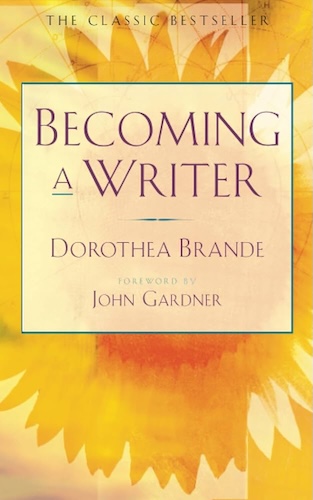
In Becoming a Writer, Dorothea Brande recommends separating the creative and evaluative stages of writing — draft freely first; analyse and revise later.
That’s pretty standard writing advice, and prompts make it easy to follow. You’re springing from a suggestion, not writing something precious to you, so your inner critic has less to latch onto.
Just as important, but a little less standard, is her advice to learn to write on demand to prove to yourself that you can. Writing to a prompt is perfect for this type of practice.
- Every day at 5pm, write for 15 minutes.
- Once that’s easy, schedule an additional 15-minute writing session at random times once a day, every day.
- Meet these appointments as a point of honour to “teach yourself that no excuse of any nature can be offered when the moment comes.”
- Don’t think about it. Just do it. Until you know you can.
- Then do it for longer periods….
That’s how you become a writer. (Well, it’s the first and most important step…)
Using Prompts to Deepen a Work in Progress
Follow a prompt wherever it takes you — even if the work it produces never amounts to anything. Simply being reminded of the journey — how characters come alive, how settings sprout with every step, how the story rises to meet you on the page — is a joy.
If you’re trying to meet a deadline to revise a novel about a recovering alcoholic, then maybe spending half an hour writing to a prompt about climate change in a comedic teen voice is not your best work effort today. But you can choose the sort of prompt you follow.
Try a prompt to enhance what you’ve already written:
- Discover what’s missing or illogical (“Rewrite a scene from another character’s POV“)
- Deepen character (“Write a childhood holiday memory as the MC’s stream of consciousness“)
- Experiment with structure (“Frame the story within a future deathbed scene where one character recounts it...”)
- Add imagery (“Choose one sense other than sight and revise all descriptions in a chapter to include it“)
- Refresh a limp idea (“Revise a story as if it were part of an anthology about betrayal...”)
That’s not procrastination, is it?
Prompts are Therapeutic
Sometimes the best use of a prompt is to distract yourself from your writerly neuroses (“I’ll never finish anything… “I’m no good at this… “What’s the point, I’ll never sell it…). Get over yourself for thirty minutes by focusing on the work.
In these cases, a language-based prompt might be best:
- “Write a 1-sentence character description exactly 50 words long...”
- “Revise an action scene without adjectives or adverbs”
- “Rewrite any page without using the letter M…”
By drawing your focus to individual words, this type of prompt takes a sideways approach to ideas and stories and that shoves all your baggage out of the way.
The Work You’re Meant to Do
And what about discovering the work you’re meant to be doing? Well, that would be:
- Write this story as if it’s the last thing you’ll ever write.
I have to admit, that one’s a bit scary. I’ve used it only now and then. But it’s a good one.
Set aside a weekly prompt time — why not make that your WISH time? (Write in Silence Hour. Come on! Are you not doing that yet??) Sew some seeds with a prompt. Who knows what you’ll reap?
If you need ideas, check out my Tarot Prompts for Writers. (No, I’m not a witch. I just like the pictures and stories…)

And check out my new story, “Get Away.” Then write your own story with the same first line. I’d love to read it.
Maybe you’ll get yours featured in DarkWinter Literary Magazine, too. They publish new fiction and poetry every week. (My story, “Social Animals” was featured in 2024 and “Everything Goes Wrong” appeared in 2025.) They prefer short works (under 2K) and they especially like pieces with a twist.
Have a fabulous Friday.
 Catherine Austen