

(Catherine Austen’s DIY Writing Workshop #3)
No idea what to write? Follow this 7-step process to turn a single word into a complete story.

1. Pick a word.
You can pick any word from the dictionary or choose one of these suggested five:
river / prize / puppy / closet / soup
I choose “closet.” (It’s a boring choice. I’m leaving the best words for you.)
The trick to succeeding with this prompt is quick decision-making. Don’t deliberate. Just make a choice. Pick a word.
2. Turn the word into a situation.
Brainstorm three story situations or premises to go with your chosen word.
E.g., for “closet,” three ideas are:
- A person is hiding in a closet.
- An animal is trapped in a closet.
- A closet is a portal to another dimension.
For “puppy,” three ideas might be:
- A person finds a lost puppy.
- A puppy is born on a pirate ship.
- A puppy can read human minds.
Again, the trick is a rapid no-stress style. Just propose some ideas, 1-2-3.
Then pick one of those ideas to make into your story.
I choose #1, “A person is hiding in a closet.” What do you choose? (Choose #3, A puppy can read human minds. I want to read that story.)
Great! Already you have an idea of what your story will be about. Way to go!
3. Write down questions about your premise.
Make like an investigative journalist and ask of your basic idea: who/ what/ where/ when/ how/ why?
To keep the no-stress momentum going, don’t worry just yet about answering any questions. Simply brainstorm questions you might ask.
E.g., for “A person is hiding in a closet,” I’m going to ask:
- Who is hiding? In whose closet? Who is with them? Who knows they’re there?
- What kind of closet? What’s in the closet? What does it smell like in there?
- When are they hiding? What year? What time of day? When do they plan on leaving the closet?
- Where is the closet? In a house? A hotel? A hospital? What country? What planet?
- How long have they been hiding? How did they get in here? How are they going to get out without being seen?
- Why are they hiding? (The biggest question of all.)
For “A puppy can read human minds,” you might ask:
- Who is this puppy? Who owns the puppy? Who discovers the puppy’s ability? Who’s going to tell the story — a human or the puppy?
- What is the puppy doing with the info she gathers? What nefarious plan does she discover by mind-reading? What trouble might her ability get her into?
- Etc. Write down a whole bunch of questions.
4. Answer some of your questions.
Commit to a few ideas by answering your questions. Try to keep this stress-free and make rapid choices. Absolutely nothing important is resting on these decisions.
You don’t have to answer every question you came up with, but answer those you find interesting. (Probably in just posing questions, you started to think of possible answers. You might have skipped step 3 entirely and just start answering questions. That’s okay.)
You might find that your answers lead to more questions, or to more ideas you hadn’t considered yet. That’s good! Those questions will lead you through your story. Write down all the ideas that appeal to you.
E.g., for my person hiding in a closet, I decide:
- Who? A girl is hiding; her name is Sophie; she’s hiding in her older sister’s closet; she’s alone; the dog knows she’s there. (Does the dog give her away?)
- What? It’s a walk-in bedroom closet, with shelves and racks, a shoe tree, and a hamper. It smells like dirty gym clothes. (Will she groan and cough and give her hiding spot away?)
- When? It’s January, present day, 9:00pm. (The sister, Nala, is out with friends, not due back until 10:00.) Sophie isn’t supposed to be there.
- Where? A small house, a duplex, in an Ottawa suburb. A nice crime-free neighbourhood. Nala’s bedroom is way bigger than Sophie’s. Life is so unfair for the youngest sibling.
- How? Sophie hid just now when she heard Nala get home early. She’s with friends, thumping up the stairs. Oh no! Sophie can’t escape without being seen.
- Why? She was borrowing a sweater without permission. Sneaking it. As little sisters do.
Your turn. Answer your puppy questions, or at least a few of them.
Perfect! You’re on your way to a fascinating story.
5. Plan – or write – a story opening based on your answers.
Sum up your decisions. You’re committing to your idea here, and finalizing the who/what/where of how your story begins.
You have enough to start your story already. You can keep planning or begin writing the actual story. Plan it or pants it — up to you.
E.g., Planning the closet story opening, I might write:
“Sophie, a 12-year-old kid in suburban Montreal, is borrowing her older sister’s sweater without permission when she hears her sister and friends come home early, so she hides in the closet.”
Freewriting the opening, I might write:
“Nala would have my head on a stake if she knew I was in here borrowing her pink cashmere cardigan again. It’s buried in a drawer with T-shirts and hoodies – she really needs to organize this closet. And install an air freshener. Oh no! She’s home early. There must be five of them coming up the stairs! I squeeze among the dresses and hold my breath….
Your turn. Let your telepathic puppy start his story. He was just adopted into a big human family and he’s out on his first walk in the city, reading minds as he goes…
6. Think of a problem that arises from the situation you’ve created.
OMG, the puppy discovers that someone is planning a terrible crime that will totally spoil his new family life. (Murder? arson? a bylaw banning dogs?!) How can he stop this horror before it starts?!?
I’m really getting into your story by this point.
The problem you come up with in this step is the crux of your story. It’s what the rest of your story will be about. Go with whatever idea grabs you.
To complicate your plot, ask questions and brainstorm to learn more about the problem and what your character might do to solve it. Or just keep writing the scene, and the next scene, and the next…
E.g., for my hiding-in-the-closet story, the problem is:
While hiding, Sophie overhears her older sister Nala talking with friends about a shocking secret…. (They’re aliens? They’re bullying someone? They’re plotting murder? They’re running away?) … They’ve been robbing people at night, stealing things left in cars and on porches. They’re criminals! And super pleased with themselves. Those little rotters.
What is Sophie going to do with this information? Will she tell? Will she keep silent? Will she join their crime spree? Or will she right their wrongs? (She’ll right their wrongs.)
7. Brainstorm — or freewrite — your plot and ending.
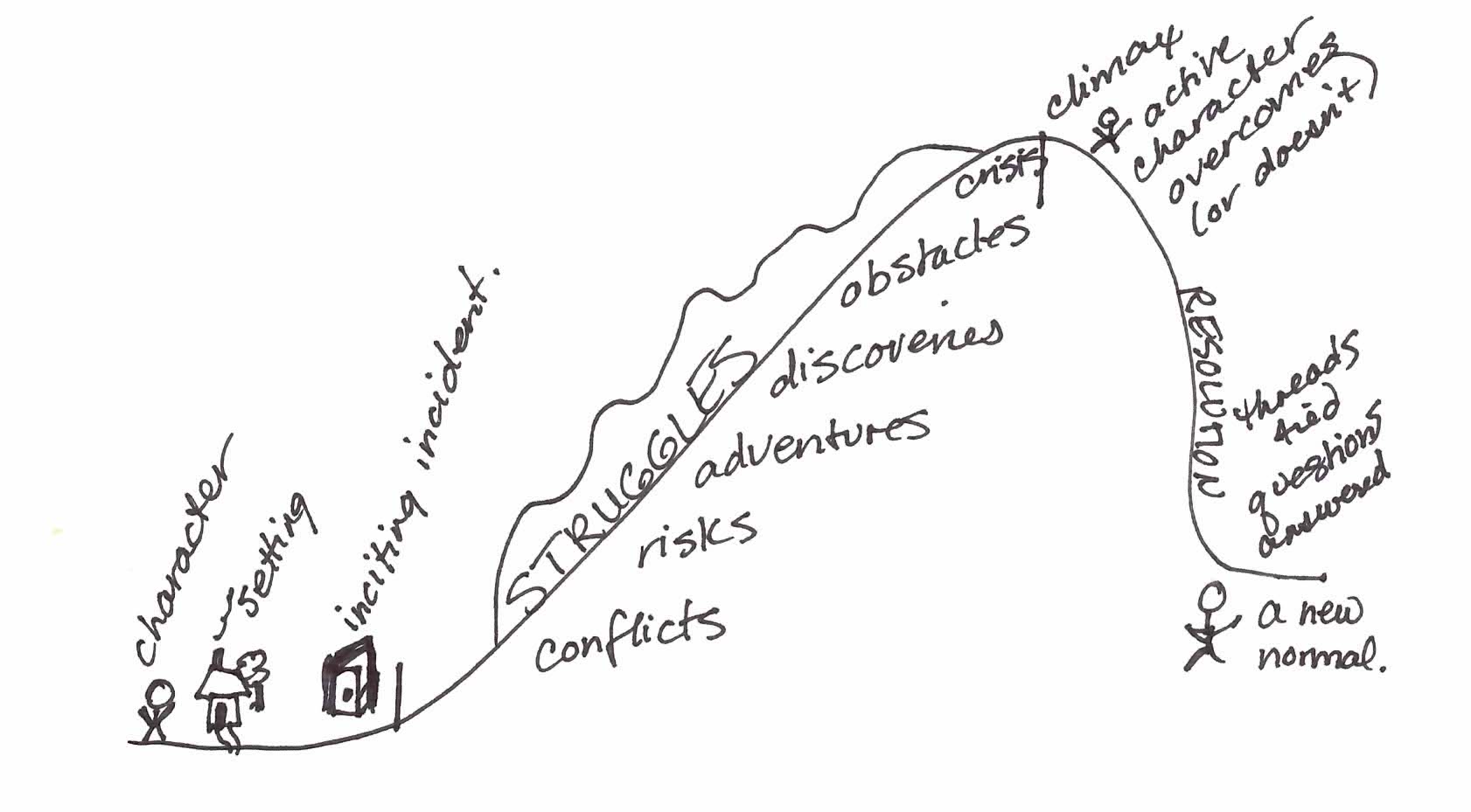
Brainstorm more troubles for your character, ways they might try and fail to solve the problem, more problems their actions might lead to, more reasons they need to succeed. Make the situation more fraught and make your character desperate to overcome it. It calls on all their ingenuity.
Write down — or just think up — a list of possible plot complications for your opening scene and for the rest of the story.
E.g., for my hiding-in-the-closet story:
- Sophie overhears Nala say, “Let’s hide the loot in the closet.” Tense moment when Sophie might be discovered.
- Tonight’s loot is a pricey electric guitar. Sophie knows who owns it, and she knows something terrible will ensue if he doesn’t get it back.
- Maybe he borrowed it from music school and he’ll be expelled from the school and his father’s house if he doesn’t return it.
- Or maybe he’s the leader of a violent gang and he’ll find out who took his fave guitar and he will take revenge.
- Sophie’s a timid kid who just wants this problem to go away, but it weighs on her. Maybe she idolized her sister and now she questions everything she thought she knew about her family.
- Maybe she finds more stolen goods around the house. Or her parents do. And they’re police officers.
- Maybe Sophie tries to find out why Nala is stealing and help her find a better path. (Nah. Too dull.)
- Maybe Sophie grabs the guitar and becomes a busker? (Nah. Too left field.)
- Maybe Nala frames little Sophie for her thefts! (Definitely.)
- Now Nala is punished by their parents and sought by the criminal gang. (If only she had a telepathic puppy to help her!)
There are many plot possibilities. But Sophie will not let Nala get away with her crimes and betrayals. And your puppy will not let the sneaky criminal ruin the neighbourhood. Right?
Get writing. I need to know what happens.
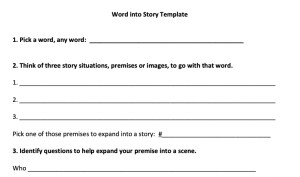
Use this handy handout to try this 7-step Word-into-Story process with other words, too.
Never again say you have no ideas for a story. You have a zillion ideas! Look at you go!
Need more ideas?
- Do a character sketch.
Follow my DIY Know-your-Character workshop and do a complete Character Sketch for your puppy/sister/whoever.
- Do a setting sketch.
Follow my DIY Know-your-Setting workshop and do a complete Setting Sketch for your suburb/bedroom/wherever.
- Start writing.

Even if you have no ideas beyond a word or image, begin to write your story. Write whatever comes into your mind.
Ideas will rise up to meet you on the page. 🙂
Good luck!
 Catherine Austen