
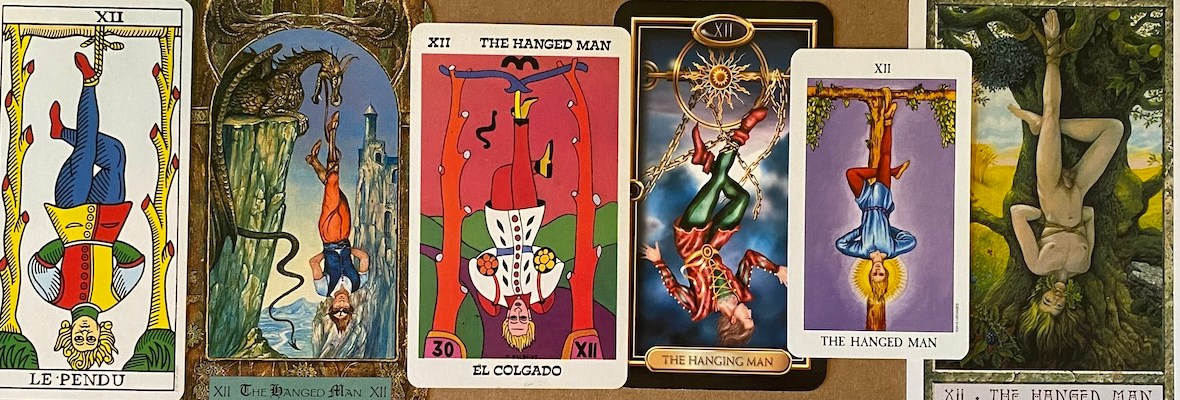
(Tarot Prompts for Writers)
Keep the image and meaning of the Hanged Man in mind as you develop a story. But go beyond the card — don’t stress about any aspects you “should” include. The card is just a tool to prompt ideas. You can take it anywhere. Be disciplined and finish this story.
First line prompts
- I was the first to discover him hanging by the gateway.
- Good things come to those who wait, my mother always said — but she’s dead now, and I’m not waiting one more second.
- The sky was red, one solid shade, from the horizon to the high sun, as if god had laid a thick plastic dome on the world and left us to our bloody games.
Continue the scene for another 500 words, in any direction you wish to take it. Change to third or first person or switch genders as you see fit. Make this an opening to a longer work or a complete flash fiction.
Setting Prompt
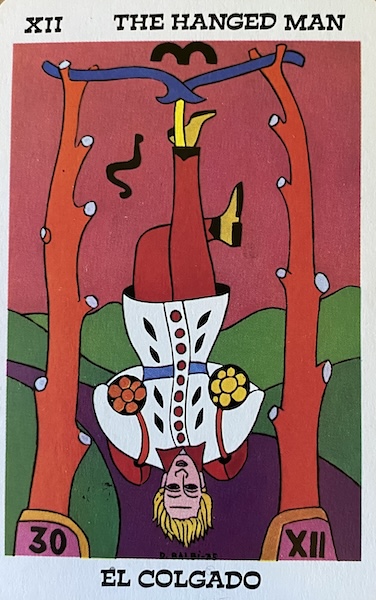
Your story opens on a blocked path.
Maybe it’s exactly like the card at left: an open road through low green hills. Or maybe it’s radically different. Maybe it’s a footpath through trees, or a goat-path through a hoarder’s house. Maybe it’s a wide dirt path crowded with evacuees on a hot day, or a narrow rocky path across a gorge lit up by the moon. Whatever kind of path you choose, it’s blocked by something or someone.
Remember the meaning of The Hanged Man, but go beyond the card to imagine any blocked path that strikes you as a promising setting. Close your eyes and picture this place and feel the character who’s approaching it.
Consider the time and place. Is it here and now? A post-apocalyptic future? Neanderthal days? Is this a rainy spring day, a hot dry summer night, a winter blizzard with the path barely visible? Is this the path souls take to judgment? There are no limits to your fictional setting — any blocked path will do.
Your character approaches and finds their path blocked. What do they feel? What do they do? What do they want to get toward or away from? What’s so special about this path?
Feel the landscape — what can you see, hear, smell? What’s the temperature? What’s the mood? What might happen here?
Now show this setting to your readers.
Planners can do a setting sketch — time and place, five senses, maybe a map, and notes on how things got this way.
Pantsers can write a paragraph or three describing this path as your character realizes it’s blocked.
POV Prompt
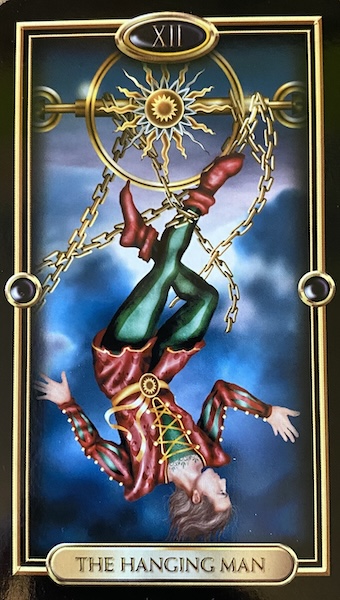
Tell the story of some recent small event in your life (or an oft-told moment of family history) from an upside-down point of view. Completely upturn the way you’ve seen or told yourself the story thus far and transform it into fiction.
That time you did or said something nice to a stranger and felt pleased with yourself — tell that story from the point of view of the stranger who absolutely hates you.
That time you honked at a car in front of you five seconds after the light turned green — tell that story from the point of view of the distracted driver ahead, who’s coming home from their child’s funeral.
That family Christmas where you got the bike you always dreamt of — tell that story from the point of view of parents worried sick over their finances as they put on what might be the last happy Christmas before eviction.
Real life offers myriad tiny moments you can twist into interesting stories via an upside-down point of view. Take any such moment in your life and deepen it into a surprising scene.
Happy writing!
Images on this page are by the following artists: Banner, left to right: Marseilles deck engraved by Nicolas Conver; Dragon Tarot illustrated by Roger and Linda Garland; Tarot Balbi by Domenico Balbi; Gilded Tarot by Ciro Marchetti (also shown in the box); Radiant Rider-Waite deck illustrated by Pamela Colman Smith; Druid Craft deck illustrated by Will Worthington.
 Catherine Austen