
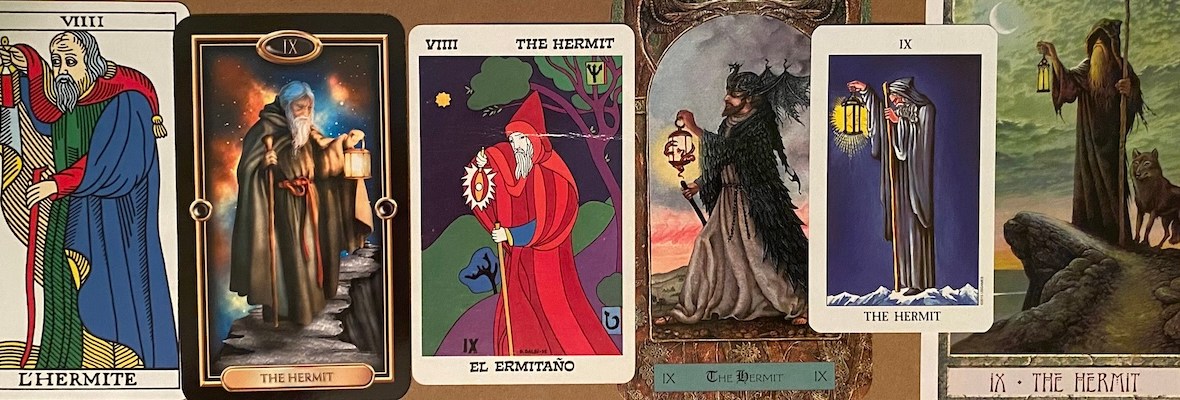
(Tarot Prompts for Writers)
Keep the image and meaning of The Hermit in mind as you develop a story. But go beyond the card — don’t stress about any aspects you “should” include. The card is just a tool to prompt ideas. You can take it anywhere. Write a tale of caution.
First line prompts
- The light flickered in my hand, but there was no wind.
- “Oh my god, not this guy!” Jamie said.
- The tree had been growing by the rocky path for three hundred years, and the old man who walked toward it felt like he’d been journeying all that time.
Continue the scene for another 500 words, in any direction you wish to take it. Change to third or first person or switch genders as you see fit. Make this an opening to a longer work or a complete flash fiction.
Object Prompt

A light.
Ponder the meaning of The Hermit, but go beyond the card to imagine any light at all and the story it might illuminate. This light could look like the handheld lantern in the tarot card — but it doesn’t have to. Imagine any light that excites you.
Picture your light. Imagine it in a setting. What does it look like, feel like? Is it hot? Does it make a sound? Is it portable? How heavy is it? Where is it located? What’s it powered by? What does it illuminate?
I like the idea of a light that can illuminate the interior of things, not just the exterior. A magical light that can expose a soul, a lie, a disease. A light in which certain people are invisible, or other creatures become visible. But all lights are useful. Perhaps yours is a nightlight, a UV light, a jar of fireflies. Whatever sparks a story idea is the light for you.
As you imagine your light, think of the characters who might be in its story. Who created the light? Who is using it? What are they doing in its light? Do they like the light or are they trying to escape it?
Write a scene where a character makes an important discovery by this light.
Fact-into-Fiction Character Prompt

Think of a hermit, any hermit. Maybe it’s someone whose work demands that they live in isolation — a lighthouse keeper or someone who does remote environmental monitoring. Maybe it’s a solo explorer — someone traveling alone by boat, by foot, by submarine, in contemporary or historic times. Or maybe it’s someone who simply wanted to escape society, someone living a life of basic subsistence on their own. (Christopher Knight comes to mind, but there have been others who were found, dead or alive, after fewer than his 20 years of solitude.) Perhaps it’s someone employed as a hermit back in the day when it was cool to have a hermitude on one’s estate. Or maybe it’s someone who was banished into exile alone.
Choose whatever based-on-a-true-story hermit scenario grabs you and expand it into a full fictional character. Leap away from reality — put your lighthouse keeper on another planet; put your traveller in a post-apocalyptic future; put your exile into a nightmare middle school; transport your biological researcher beyond the Cenozoic.
It’s up to you whether your protagonist has lived alone for many years or is just starting out on the hermit life. But they are, or have been, or will be, alone for a long long time. How they feel about that is at the heart of your characterization.
Consider the character’s exterior (species/gender/age/abilities) and interior (temperament/interests/beliefs/fears). Think about their history — what drove them to this isolation? What do they do all day, alone? How do they feel about whatever life they left behind? Do they intend to return to it?
Now show that character to your reader.
Planners can write a character sketch and a diary entry about their day’s work and something unusual that happened.
Pantsers can write a scene of the character thinking, speaking, and acting as their solitude is disrupted.
Happy writing!
Images on this page are by the following artists: Banner, left to right: Marseilles deck engraved by Nicolas Conver (also shown in the box); Gilded Tarot by Ciro Marchetti; Tarot Balbi by Domenico Balbi; Dragon Tarot illustrated by Roger and Linda Garland; Radiant Rider-Waite deck illustrated by Pamela Colman Smith; Druid Craft deck illustrated by Will Worthington.
 Catherine Austen