
(Tarot Prompts for Writers)
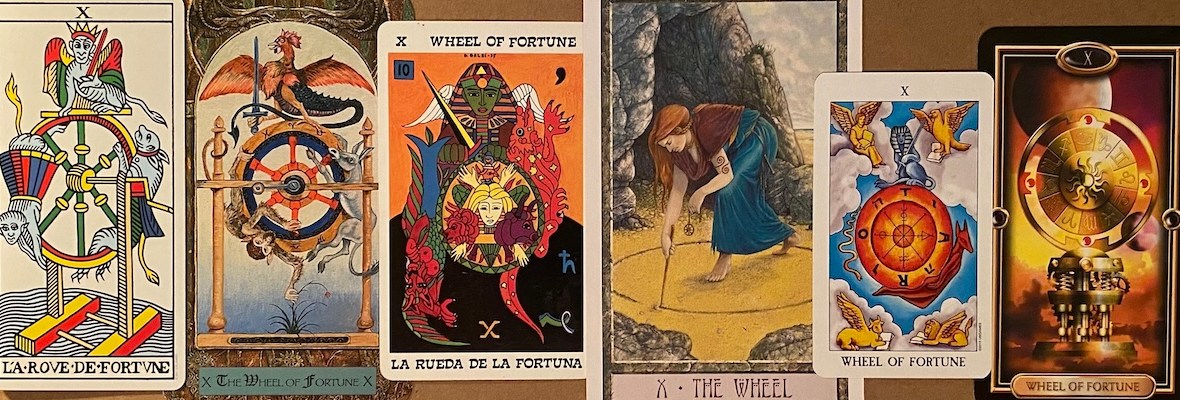
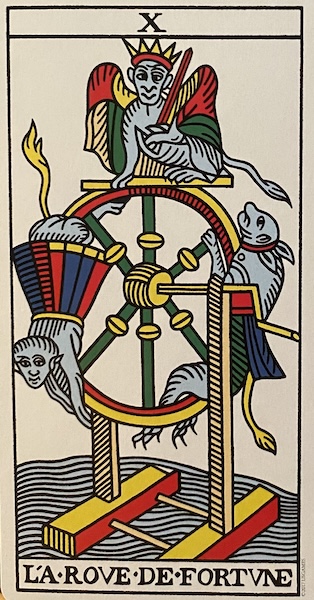
Keep the image and meaning of The Wheel of Fortune in mind as you develop a story. But go beyond the card — don’t stress about any aspects you “should” include. The card is just a tool to prompt ideas. You can take it anywhere. Write a circular tale.
First line prompts
- I am without a kingdom.
- He arrived, finally, at the pinnacle — a self-made man, alone, a self-appointed king — but something scuttled after him.
- She was pretty sure this wasn’t rock bottom, but the possibility of a worse place was enough to steer her upwards.
Continue the scene for another 500 words, in any direction you wish to take it. Change to third or first person or switch genders as you see fit. Make this an opening to a longer work or a complete flash fiction.
Object Prompt

A wheel.
Ponder the meaning of The Wheel of Fortune, but go beyond the card itself to imagine any wheel that sparks a story idea. It might look like the Wheel of Fortune — but it doesn’t have to. Close your eyes and think of wheels turning.
What comes to mind? A hamster wheel? Cogs and wheels? A ferris wheel? A Catherine wheel? A roulette wheel? A giant statue of a wheel?
What does your wheel look like, feel like, sound like? What size is it? Where is it located? What is it made of?
Who made it? When? For what purpose? Who is looking at it now? Looking for it? Running away from it?
Write a scene where characters argue over this wheel and how they should best deal with it.
POV Prompt
When you’re up, you’re up, and when you’re down, you’re down. But what do you think about being down when you’re up, or being up when you’re down? (If you think about it at all, which most of us don’t. The best thing about health and happiness is the certainty that you’ll never be sick or sad again. Nope. That’s all behind you now…)
Tell a story from the point of view of someone who knows the full story, the whole circle, the lie behind the words, “The End.”
Tell the story of a rise — to love, fame, wealth, or power — from the point of view of one at the very bottom. Maybe they’re nostalgiac, or dreamy, or bitter.
Or tell the story of a fall — into loneliness and disruption, infamy or irrelevance, poverty or powerlessness — from the point of view of one who has it all, for now. Maybe they’ve been down before. Or maybe they can see the end that’s coming.
Think about your narrator. How did they get they get to this position? Are they narrating their own story or the story of someone they’re witnessing? Someone they want to protect? Or someone they want to murder?
Planners can write a character sketch and a diary entry about the view from here.
Pantsers can write a scene of the character thinking, speaking, and acting as their fortune changes.
Happy writing!
Images on this page are by the following artists: Banner, left to right: Marseilles deck engraved by Nicolas Conver (also shown in box); Dragon Tarot illustrated by Roger and Linda Garland; Tarot Balbi by Domenico Balbi; Druid Craft deck illustrated by Will Worthington; Radiant Rider-Waite deck illustrated by Pamela Colman Smith; Gilded Tarot by Ciro Marchetti.
 Catherine Austen